

quincy
-
Posts
335 -
Joined
-
Last visited
-
Days Won
10
Content Type
Forums
Gallery
Store
Everything posted by quincy
-
Just press, don't hold.
-
Yes, sorry. I should not post in topics that are this active. I'm just too damn slow.
-
Mh, okay. I fear I must repeat what darknj already wrote, hope he is not angry about that: Your ND 0.9 is not nearly strong enough for what you are up to. It only reduces the light 3 stops. As darknj already said, even 1-3 seconds is too long. For what you want, you need a ND 3.0, often also called "ND1000", probably even combined with your ND 0.9. Or you can stack multiple images you took with photoshop, for the total time of exposure you want. That means, if you take the images at 1/10th of a second with your ND 0.9 on, you can make 30 images for a total of 3 seconds of exposure. /edit: I was too slow, most of this has already been written. However, if you decide to buy a new ND filter, I can recommend the NiSi ND1000. No color cast, no problems, slim frame.
-
There are a few informations missing before anyone could help you. - What ISO? - Which ND-Filter? Covering the viewfinder on a mirrorless camera is useless.
-
The third image in the posting is actually shot with Fujifilm. Hover over the images with your mouse to see the image titles, it confused me at first when I read the posting. The Canon shots always seem to be those with a lot of chromatic aberation. I guess the sharpness falloff has to do with the cardboard being bent, because it is the same with two different cameras and two different lenses. To conclude, I must say I'm surprised by the results now. When I saw the images in the first posting, I was sure there had to be something wrong, because the XF 56 had to be better than what we saw there. But as it seems now, the out of camera jpegs are even superior to the Canon images. I knew that the Fujinon lenses are pretty good, but I mean, look at the last two images in the posting (of the christmasbauble). Yes, the 5th one might be a bit oversharpened in the camera, but it's a lot better than the 6th image (I suppose these are 1:1 crops again). I expected the XF 56 to be close to the Canon 85/1.8, but this looks like it is beating the Canon workhorse lens! Perhaps those images are a bit unfair towards Canon now? I would really try the Capture One trial. The lens is probably not the problem. As a starting point for sharpening, try to set the sharpening amount to 180, clarity to 5 and structure to 7. Gives me good results with fur and feathers (XF55-200).
-
It's not motion blur, that's obvious. My concern rather had to do with the approx. 6 mm of DOF, of which perhaps 2 mm are really sharp. If you focus manually and your subject moves just slightly forwards or backwards when you press the shutter button, this would be the result you get, even with the sharpest lens. If the OP decides to do test shots on static subjects, I'd recommend also trying the autofocus.
-
Well, at least the XF 56 does not show as much CA as the Canon! But to get serious: This looks strange to me. I've looked at your images and noticed some things. First: The iris in the Canon image is about 137 pixels in diameter, while the irides in the Fuji images are about 107 pixels in diameter. And while bigger images usually look better, and I'm confident that this fact is a part of the difference in perceived sharpness (but for sure not THAT difference), there is also another thing about it: The linear resolution of the 6D is about 12% higher than the X-T1's, but the iris is about 30% bigger. So you were closer when shooting with the Canon than you were with the Fuji. Which brings me to the second point: I don't know how many images you took with the 56 or how the whole images look since you gave us only those crops, but could it be possible that the focus was not on the eye? I'm not implying that you are not able to focus right, but we all know about the quirks of the Fuji bodies regarding focusing. It would help if you tried to shoot something static. I know that's not the same as photographing real faces, but it will take the human factor out of the equation for this lens comparison. In the end, I guess it's a combination of all those factors. Different resolution, different distance to subject, RAW developer handling the files different, and so on. You might download the free trial of Capture One to see if the Fuji images get better. But if it does not get better, I'd return the XF 56mm F1.2 R, because even pictures taken with my XF 27mm F2.8 at f/2.8 are sharper than what you showed. P.S.: I don't see the images 4&5.
-
Brand spanking newbie from NYC - please help!
quincy replied to soozy's topic in Newbie / Self Introduction
There is a lever below the shutter speed dial that locks the camera to "full auto", no matter what you do with the other dials. Try to switch it away from the auto position. -
unfortunately the xps 13 has an automatic content-dependent brightness control that cannot be deactivated at the moment, and it remains to be seen if dell will deliver a software update for this issue.
-
Oh, did not see that. When shooting RAW, the in-camera white balance setting is almost irrelevant. It's just a value written to the EXIF data. There is, however, a reason why there is no "flash" white balance. While cameras with built in flash can be calibrated to the color temperature of the built in flash, the camera manufacturer does not know what color temperature your external flash has. So, if you want to do the WB in camera for your RAW file (your RAW converter will use this value as preset), look what color temperature your flash has (data sheet), and just dial it in with the "K" setting.
- 5 replies
-
- 1
-

-
- raw
- portraiture
- (and 2 more)
-
The problem here is setting ISO at "L". The lowest native ISO setting for this sensor is 200. When choosing "L", the camera takes the image at ISO 200 and calculates a "ISO 100" jpeg for you. Hence, no RAW.
-
When using the estimated euro pricing for the new fujinon tele-zoom, you should compare european prices for the other lenses. Canon EF 100-400mm 4.5-5.6 L IS USM : €1250 Canon EF 100-400mm 4.5-5.6 L IS II USM : €1950 Nikon AF-S VR 80-400mm 4.5-5.6G ED : €2150 For me, fuji's rumored proposed retail price sounds good in this context, regarding that the price will go down after release.
-
Well, so far I've used more than 10 different SD cards with my X-T1 (8GB-32GB, microSD with adapter, Sandisk, Transcend, PNY...), and I did not format any of them prior to first use. They all worked. And why wouldn't they? SD cards are pre-formatted by the manufacturer, usually FAT32. Therefore, it's not totally unthinkable that the OP and others used SD cards without formatting before. To the OP: do you know how the SD card was formatted before you reformatted it in the camera?
-
Seems to be like that... Here's a link describing the same thing: http://www.lightingrumours.com/nissin-i40-fuji-review-7125 excerpt: "For example, when the face detection is turned on it is only possible to fire the flash with a preflash for red-eye reduction. This means there is a little delay between pressing the shutter button and actually taking the photo. OK for an amateur, but unacceptable for a pro. When you change the camera from RAW to JPEG+RAW suddenly it is possible to deactivate the red eye preflash, but not inside the normal flash menu, in a separate menu option." May I ask why you don't shoot in RAW+JPEG mode? It is beneficial for reviewing your images in camera, since the embedded jpeg in the raw file has a much lower resolution, which makes it harder to check focus. /edit: this form of red eye removal does not seem to be connected with jpeg-processing, it is hardware. Short pre-flash to force the subject's eyes to close the iris and thus prevent or weaken red eyes.
-
I don't have a X100/s/t, so I cannot contribute very much, but about the XT1: When used in 'EVF only + Eye Sensor' mode to show the live-view only in the EVF and only when the camera is up to the eye, the menu will also show in the EVF only (and only when the camera is up to the eye).
-
It's not the only lens that works for astrophotography, but it does indeed have some properties that make it, let's say, easier to get good results, depending on what you expect, of course. I'll try to keep this short and simple, so there will be a few things I don't mention or won't go into great detail about. If I miss out on something that is of interest to you, please just mention it and I'll see if I can help. In astrophotography, the subject is not very bright. In order to counter this, the gain (/amplification/ISO) as well as the exposure time need to be increased. With higher gain comes higher noise, but for starscapes, ISO-values between 3200 and 6400 will be needed anyway. Instead of increasing the gain, the exposure time could be increased further. The problem with this is, the stars are moving. The longest exposure before the startrails become visible is approximately 500 seconds divided by the focal length (in 35mm-equivalent terms). Thus, it is beneficial if the lens that is used transmits a lot of light, has a low f-stop number. Depth of field is no concern, because the lens is focused at infinity. And those two points are the reasons why the Samyang does fairly well with astrophotography: it is a very wide lens (18 mm in 35mm-equivalence), thus you can expose for 25 seconds before the stars start to form streaks, and it has a maximum aperture of f/2, which is one stop faster than the Zeiss and two stops faster than the XF10-24. And finally, its optical characteristics are good for astrophotography: It has nearly no coma. Coma is an optical abberation that deforms points (stars) to slightly cross-shaped objects with a comet-like trail towards the corners. Of course, all of this only helps if your goal are starscapes. If you want to take images of nebulae, you need a longer focal lenght. As said above, with a longer focal lenght star trails (and the movement of the sky in general) shows earlier. And longer focal lenghts often have a lower f-stop. therefore, you need a tracking device that moves your camera with the firmament.
-
http://www.metz-mecatech.de/en/lighting/flash-units/system-flash-units/mecablitz-44-af-2-digital/product-information.html Starts shipping in december. /edit: more precise link: http://www.metz-mecatech.de/en/lighting/flash-units/system-flash-units/mecablitz-44-af-2-digital/data-sheet/mecablitz-44-af-2-digital-fujifilm.html
-
Complete Overview over the available and upcoming Fuji X-Mount lenses
quincy replied to quincy's topic in Fuji X Lenses
Looks good to me, did not see that before. Thank You again for your help! Have added the 35 to the list. -
Complete Overview over the available and upcoming Fuji X-Mount lenses
quincy replied to quincy's topic in Fuji X Lenses
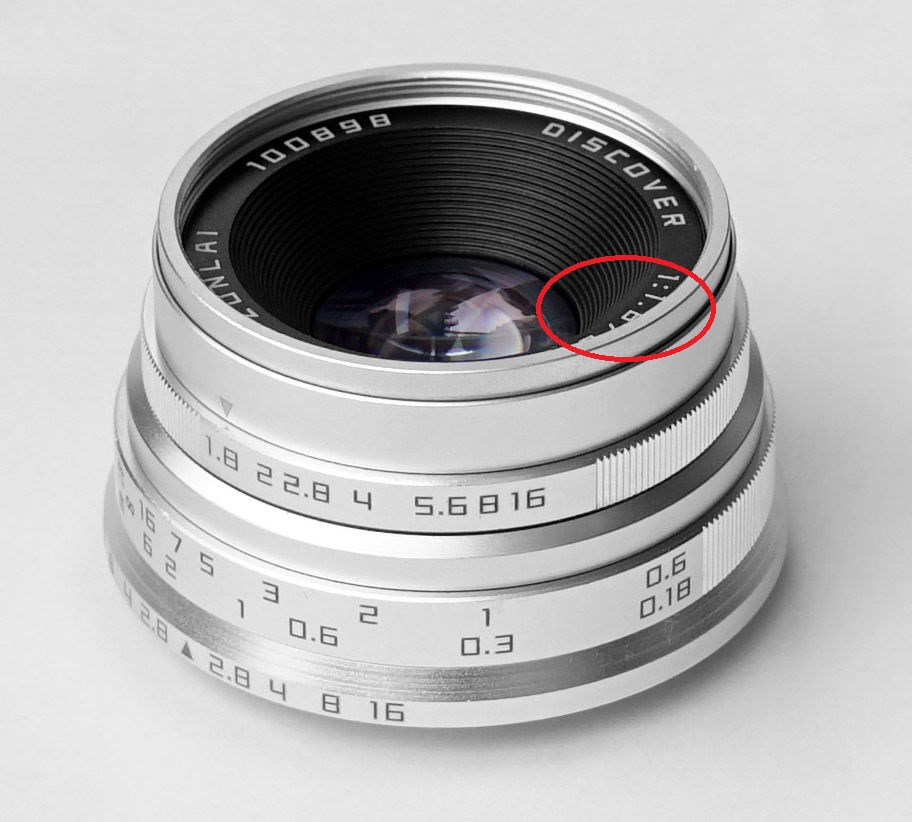
Hi all, I've just corrected the Modula Optical / Zonlai confusion I had in my chart, and have marked the zonlai 25 mm F/1.8 as released, since it can be bought via ebay. I was just about to add the zonlai 35 mm F/1.8, as I realized something strange: The stats say it has exactly the same size and weight as the 25 mm lens. And when looking at the product image, I noticed that the markings on the lens do not say 1:1.8/35, the number after the slash is rather a "2". Do we have proof that there actually is a 35mm lens? Or might this just be a mistake? (image from ebay)
-
I was about to write that it would help us to help you if you tell us where your problems are, but then I saw your second post: - For me personally, one part of the solution was to get the extended eyecup. It really helps me to block out all external light, but it depends on the shape of your eye socket, and if you wear glasses. - You can assign the evf-brightness to one field of the Q-menu. This helps to change it quicker.
-
new Firmware for X-T1, X-E2 & Co coming October 29
quincy replied to Patrick FR's topic in Fuji X Rumors & News
I'm not sure that I really understand what you mean, but I believe my focus assist button does what you are asking for. -
Complete Overview over the available and upcoming Fuji X-Mount lenses
quincy replied to quincy's topic in Fuji X Lenses
Oh, thank you! The legend/key is wrong. I will correct it when I add the Zonlai 35mm. -
I agree that the XF90 is a wonderful lens, but this year, there were many beautiful primes, the most astonishing and technically advanced being the Canon EF 35mm f/1.4L II USM, in my eyes. You may think of Canon what you want, but that lens is gorgeous. Wonder why it is not even listed. The thing is: "it depends". When shooting a upper body portrait with an 85 mm lens, you are about 1,7 m away from your subject. As we know, the distance is deciding for the look of the portrait. If you stay at 1,7 m and put the 135 mm lens on, you get a tight portrait crop with the same look as the upper body shot had with the 85 mm lens. So yes, it is kind of a speciality lens, but the decision between the XF56 and the XF90 should depend on your desired result. (full body / upper body / face portrait) And I have seen beautiful portraits shot with the canon 135/2. Fully agree with that.
-
@Jürgen Heger: You know... the thing is: Nosegunner came here, boldly stating things that were clearly wrong. That the XF 23mm F/1.4 R was optically bad and slow focusing (which he revoked already), and that a lens like the 23 F/1.4 could be built smaller without compromising image quality, which is just wrong. Making it smaller or lighter will increase vignetting, distortion, abberations or astigmatism. Or the maximum aperture needs to be decreased. The first answers he received were informative and friendly (not mine), informing him about the lens in question and his misinformation. But as he got more and more agressive and stubborn about the lens being too big and fujifilm needing to make a smaller one no matter what, so were the answers from the community. And then came you, attacking everyone on a personal level by writing stuff like "Never criticise in a Fuji forum anything that Fuji does", implying that everyone here is unobjective and just wants to silence critique. Just look around the forum, it's full of critique and suggestions for improvement! And here you are again, calling this a "bashing of Fuji critics". It's not what this is about. Had the OP started a thread themed "Who wants a little 23/2 to accompany the 35/2", the response would have certainly been different. On a side note: I guess we can agree that there is use for higher resolution sensors in different kinds of photography ("street" may not be one of them), like huge prints of product shots or my favorite: cropping. And if I'd buy a camera with higher resolution, I'd want my images to be sharp at pixel level (and thus have to adapt my shooting style), because if I would not, I'd not need the extra resolution...
-
Complete Overview over the available and upcoming Fuji X-Mount lenses
quincy replied to quincy's topic in Fuji X Lenses
Thank You! Have added them to list & chart. However, I'm not sure if 6/6, 5/5 or even 4/4 (although you need less lenses for longer focal lenghts) is enough to be corrected good enough for a digital camera. At least they are built for full frame, that might help on Fujifilm cameras.