Leaderboard

Popular Content
Showing content with the highest reputation on 05/18/2024 in all areas
-

Astro-photography (open thread)
George_P reacted to MARRIEDGUY9 for a topic
playing around with the 150-600......sharper than the 70-300 1 point
 -

minimum specs for a macbook to manage these raws in LR?
jerryy reacted to Tuxster.mk for a topic
I added an external UGREEN M.2 NVMe SATA SSD Enclosure, USB 3.2 Gen2 10Gbps Enclosure for NVMe PCIe M-Key(M+B Key), SATA NGFF (M+B) Key, Support UASP Trim Smart for 2280 2260 2242 2230 with 2 Cables, Aluminum Heatsink. inside is a 2tb wd black drive. Not exactly sure of transfer speed as i don’t wait anymore for file transfers. I use it as a working second drive. Pretty sweet and snappy addition to my mbp.1 point -
From the album: FUJI X PRO III
1 point -

Astro-photography (open thread)
MARRIEDGUY9 reacted to jerryy for a topic
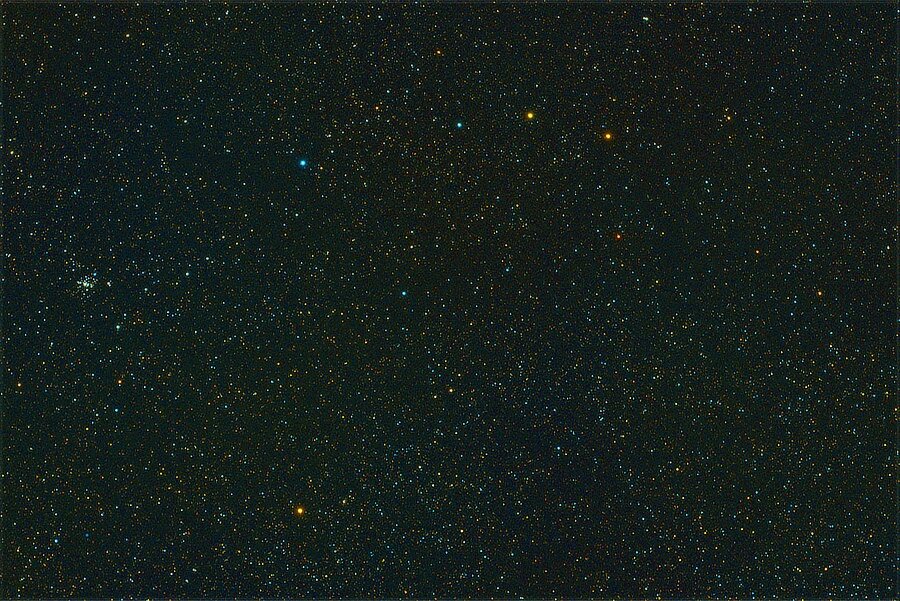
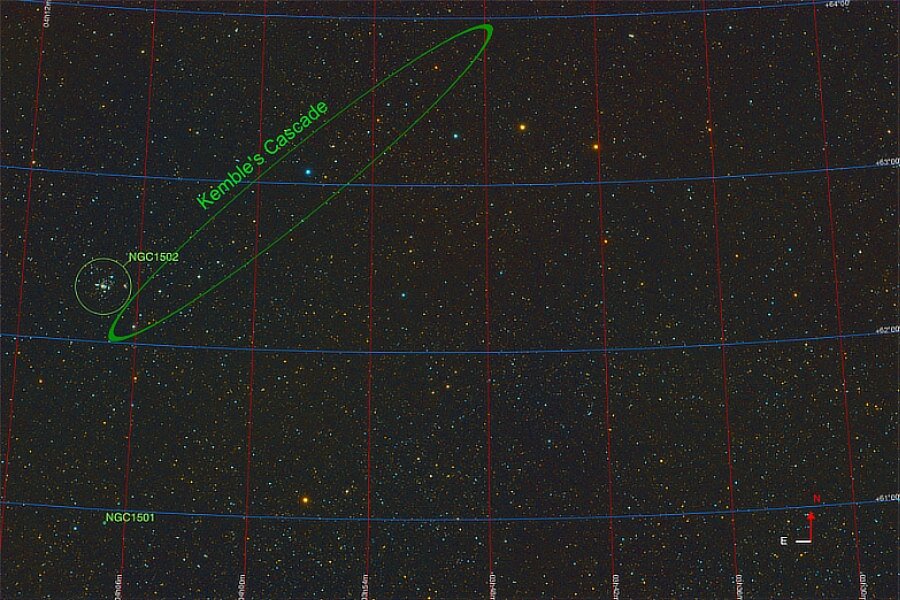
Ahoy ye hearties! Hoist ye yon Jolly Roger and Cascade away. NGC 1502 The Jolly Roger Cluster: This is the equivalent of 43 minutes, 40 seconds of exposure. NGC 1502 is a neat little cluster located in the Camelopardalis Constellation. This region of space was thought to be fairly empty by early astronomers, but as you can see, there is a lot there. Kemble's Cascade (a.k.a. Kemble 1) is named for Father Lucian Kemble, a Canadian Franciscan friar who wrote about it to Walter Scott Houston, an author for the Sky And Telescope magazine. Houston named the asterism for Fr. Kemble and the name "stuck". NGC 1501 is the Oyster Nebula. A longer focal length telescope is needed to bring this one into good viewing range, but it is well worth the effort. NGC 1502: https://skyandtelescope.org/online-gallery/ngc-1502/ Camelopardalis Constellation: https://en.wikipedia.org/wiki/Camelopardalis Kemble's Cascade (and NGC 1501: The Oyster Nebula): https://www.constellation-guide.com/kembles-cascade/ Arrrrrr Matey.
1 point -
Astro-photography (open thread)
MARRIEDGUY9 reacted to jerryy for a topic
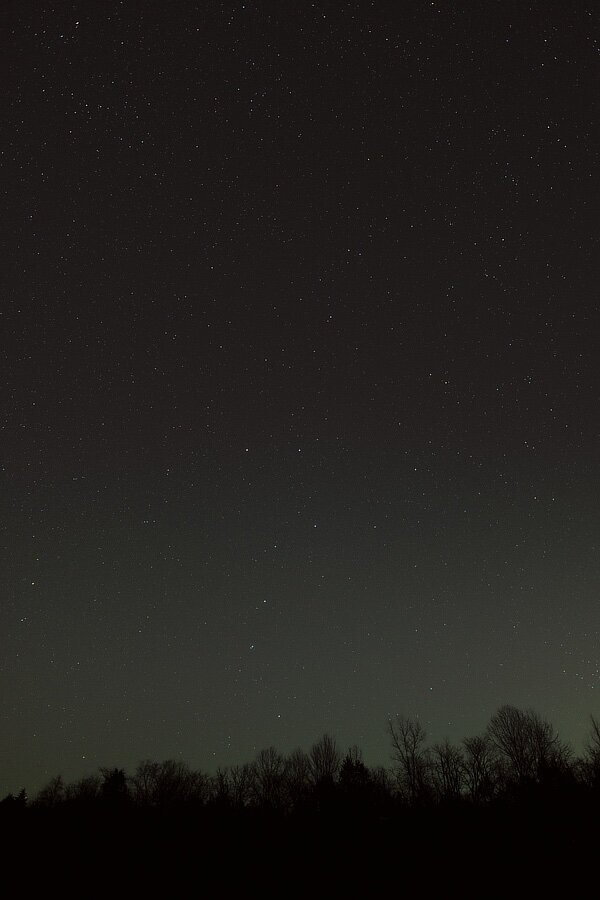
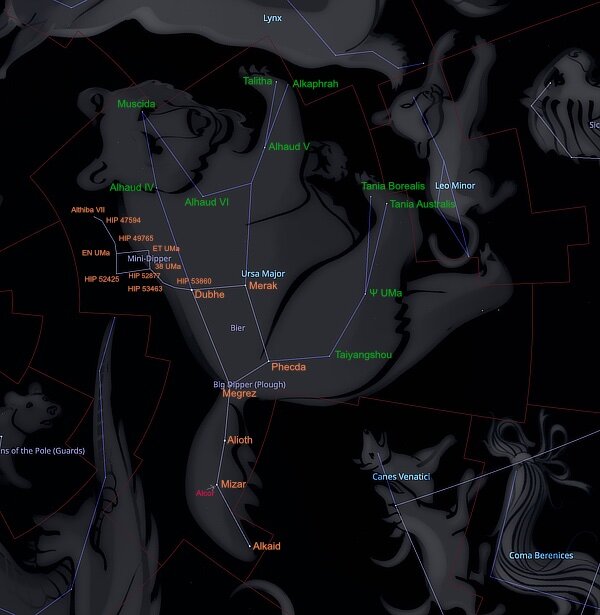
Big Bear, Big Dipper... Every now and then one of the images I post will have an asterism, which is just a pattern in the stars that is interesting to see, but the stars have no relation to each other unlike stars in constellations. There is a famous one where both happen at the same time, the stars are in an asterism and in a constellation... This is a screen capture from Stellarium, with annotated star names added on top. All of the stars are part of constellation Ursa Major. The blue-ish colored lines and the white-ish colored lines connect the main constellation stars, the white-ish colored lines alone form asterisms. The orange-ish colored labels are for the stars in the two asterisms. This is the equivalent of an 80 seconds exposure. As a side note: Alcor and Mizar are a famous double star pair, very easy to see visually or with binoculars or telescopes. http://stellarium.org/ https://www.constellation-guide.com/constellation-list/ursa-major-constellation/ https://www.space.com/ursa-major-constellation-great-bear
1 point