


Astigmatism
-
Posts
139 -
Joined
-
Last visited
-
Days Won
9
Content Type
Forums
Gallery
Store
Everything posted by Astigmatism
-
Fujifilm X Acquire sequence of operations?
Astigmatism replied to Astigmatism's topic in General Discussion
Oooooohh, so that's what's going on! Thanks jerryy! -
I use Acquire to back up my camera settings on an X-T4 and an X-T30 ii. But the sequence of steps I seem to need are a bit obscure. The manual says: Connect camera via USB, launch Acquire. It doesn't state whether the camera should be on or off. When I do that, Acquire never recognizes a camera. I've tried turning the camera on first, between these steps, and after. Nothing. What works is: Leave camera off, connect, turn camera on, launch Acquire, turn camera off, turn camera on. I haven't found a simpler sequence of steps that lets Acquire recognize a camera. I may be missing something or getting my facts wrong someplace (this requires a surprising amount of accurate short term memory!). What is supposed to be the sequence of operations? Once Acquire recognizes a camera, everything seems to work as expected. I can back up and restore camera settings. I'm using Acquire version 1.24.0.4. I've updated both camera firmwares fairly recently but think it was funny like this before the updates too. This is all on an iMac running Ventura 13.4.1 (c). I have also learned that Acquire does not connect at all if I go through a USB hub; the camera cable has to go into one of the USB ports on the iMac itself. Thanks!!
-
I think I'd vote for the 18 mm f/1.4 plus the 80 mm f/2.8 Macro. I want to be able to shoot pretty wide, which I can always crop, and I should be able to shoot fairly fast. Thus the 18. Given that, the 80 has much better reach, and can shoot quite small too. These are both lenses I own and like. If you let me have 3, I'd put the 35 f/1.4 in the middle, and pick maybe 14 mm for the wide. Or maybe even 8 mm.
-
I have the X-T30 ii and the X-T4. I prefer the X-T4 because it puts the ISO speed on its own top dial, because it's bigger and easier to handle with clumsy hands, and because it adds in body image stabilization (IBIS). But otherwise these are not very different, IMHO. I always want to set ISO, shutter, and aperture manually. The X-T4 makes that work extremely well, as if it's designed just for photographers like me, though it's also easy to put any combination of those into automatic modes. Just looking at the top of the camera tells me how everything is set, and that's where I change it. The X-T30 ii almost does that, except I have to use the rear dial to change ISO and look in the EVF or LCD to see it. Well, it's easier than loading a different film, which is what I used to have to do -- but still I really like the ISO dial on top of my X-T4! I've never used an X-S10, but I just skimmed a review of it. I don't think it accomplishes ANY of that, so it'd be a nonstarter for me. Are you a manual photographer or an automatic photographer? When I look at your options, that branching of the decision tree is the first thing.
-
I bet it was a bad description of a non-Fuji lens in a Fuji X mount version. Any clue what was with the three focal lengths listed? Zooms are normally known by their min and max focal lengths. There was a thing decades ago, lenses that had multiple focal lengths but not continuously adjustable. You'd set the lens to one of several choices. Supposedly it was easier to design the optics for good performance at just several focal lengths and not the whole range (which does make some sense). Any chance it could have been one of these?
-
Problem with "New to Me" XF 80mm f/2.8 R LM OIS WR Macro
Astigmatism replied to gussie's topic in Fuji X Lenses
Ditto. -
Note that, while the slider was set to just under 1 MB, the spider was probably set to kill the photographer.
-
Hey, THANKS, jerryy!! I found all kinds of online references about the Photos app that say you just have to play with the settings to see what you can get, but nowhere a hint of this. Here's the same image, exported from Photos as a full size full quality jpg, and then re-exported from Preview with the slider set to just under 1 MB:

-
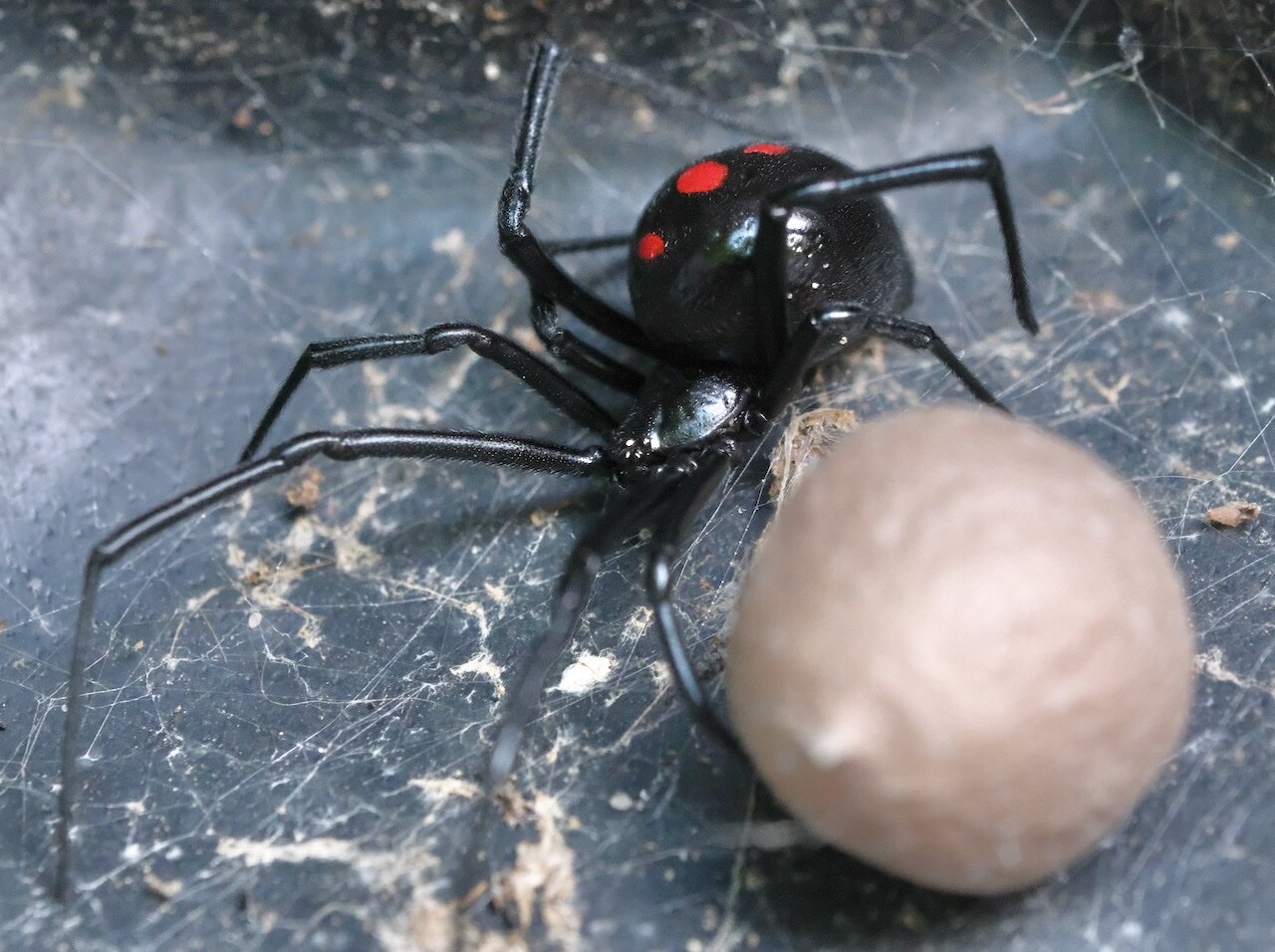
I got a better photo of her. I believe she's guarding her eggs. Fuji 80 mm macro set at f/5.6, with a Fuji 2x tele-extender making that f/11, at 1/250 s and ISO 12,800 handheld. Natural cloudy sky indirect lighting on a bright sunny day. This is slightly cropped, much less so than the others I posted. As an aside, I think we have a 1000 KB file size limit here. I played around in MacOS Photos with different compressions and sizes, trying to get just under 1000 KB, but got 1700, 1200, 1300, and what MacOS says is 302 and this posting says is 295. I don't know how to more directly specify what size I want to wind up with, in this software. Anybody happen to know?
-
To plug a focal length gap: 75mm or 50-200mm?
Astigmatism replied to G_N's topic in General Discussion
I think your question is, simply, do you like primes or zooms best? I really like primes, and I have a bunch. I have some zooms, too, but it's the primes I really treasure. So, if I were in your shoes, I'd go with the prime. FWIW I have the Fuji 80 mm macro, and it is really great for quite a lot. It's a perfectly nice telephoto, and focusing down to fill the frame with a postage stamp is a great ability, which AFAIK is missing from your set. I do also have the 50 mm f/1.0, which is amazingly fast -- it's not one of those graded aperture ones (f/1.2) that is made IMHO a bit weird just to exploit the bokeh. It's just fast fast fast. BTW I also have the Fuji 100-400. I like it very much, though now I wish I had waited to get the 150-600. I also have the 2X tele-extender, which works on both the macro and the long zoom, so I actually cover up to 800 mm. This gets as far, in angle, as the old Canon FD lens line that included a 1200 mm that I only daydreamed of in the '70s. -
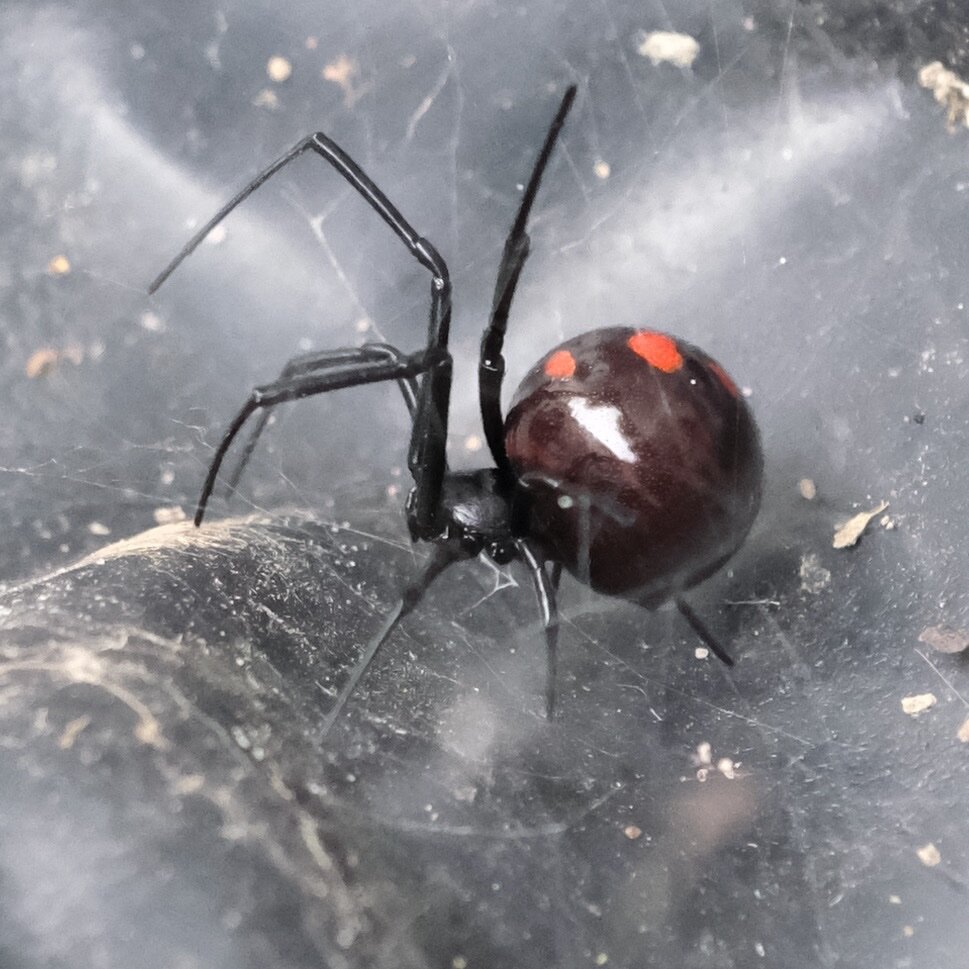
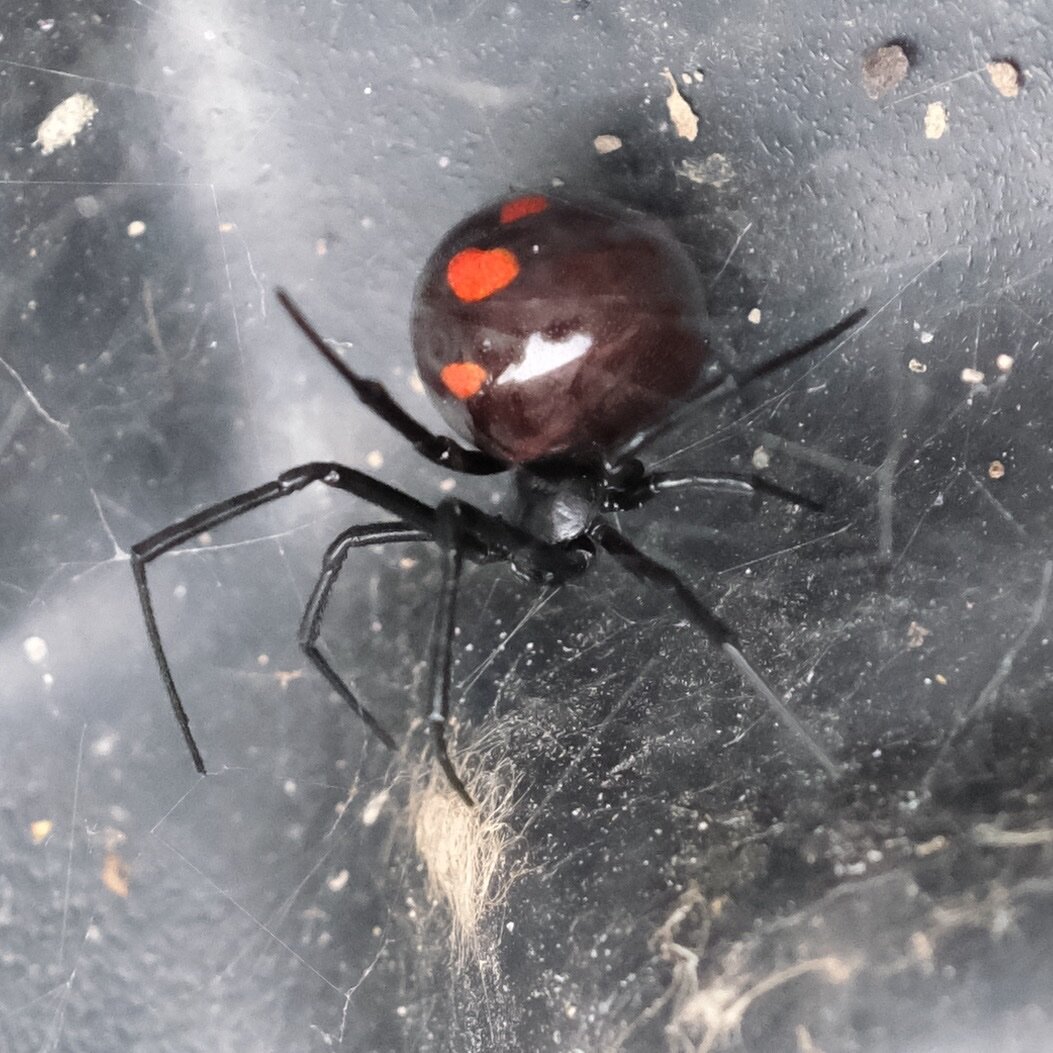
Discovered this beauty under the fake plastic boulder that covers our well, when I was mowing today. I kept my distance, and cropped after the fact, though I wish I had added my 2X extender to the 80 mm Fuji macro. Handheld at 1/1250 seconds with OIS, f/4, ISO 5000, overcast sky lighting. Google Lens identifies it as a Southern Black Widow.
-
Distortion on car photography 50mm F1.0
Astigmatism replied to Alex909's topic in General Discussion
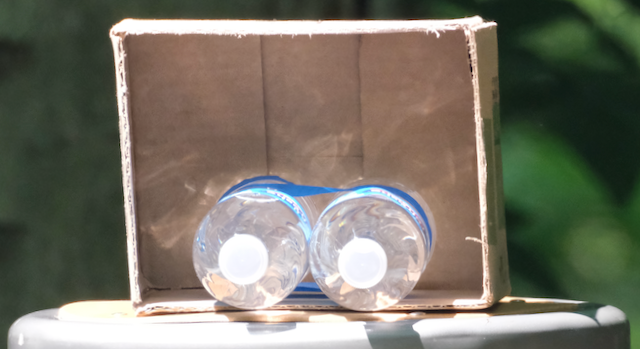
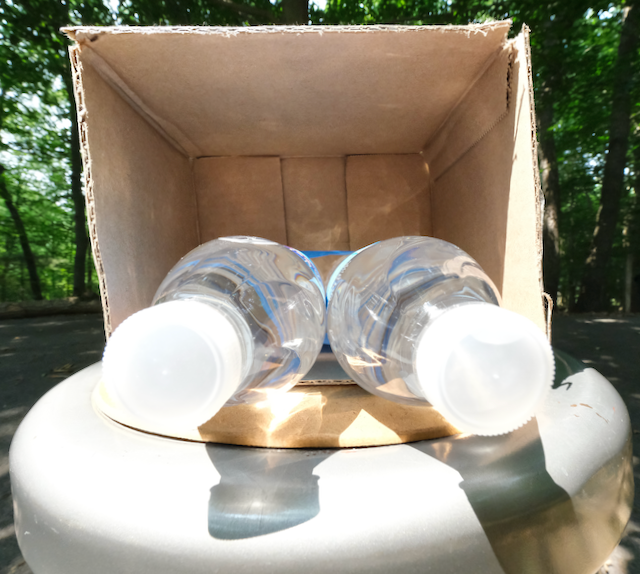
The new Fuji XF 8mm F3.5 arrived! And, with it, and with the 100-400 zoom plus the 2x tele extender, I took a couple pictures illustrating the perspective we are discussing in this thread. The long lens is 100 times the focal length of the short one. I set a workshop stool out in the driveway in full sun. On top I put a cardboard box with the flaps cut off, with two water bottles taped together inside it. I hoped this simple geometry would share some characteristics with the car in a shop pictured above. With the 8 mm lens I was able to take a picture from about 3 inches from the bottle caps. With the 800 mm lens I could take a picture from 72 feet. In both pictures the seat of the stool occupied roughly the same fraction of the viewfinder width. Then I cropped both pictures to slightly more than cover the stool seat. There's a huge difference in how the shapes look. Note how in one photo the inside side walls of the box are plainly visible (I was exposing for them) and in the other only the rear wall is visible. Also notice how the bottle caps flare wide relative to the bottoms of the bottles (which aren't visible but you can judge where they must be). All the round things are circular in the photos, and the box (though it's a bit bendy) has substantially straight outlines. Just to help with understanding the setup, I also included a very small file size iPhone photo.
-
Bets on when the 8mm f/3.5 will be delivered?
Astigmatism replied to Astigmatism's topic in Fuji X Lenses
Anybody who bet "about half an hour ago" won. More to follow... -
Distortion on car photography 50mm F1.0
Astigmatism replied to Alex909's topic in General Discussion
A bit more on that: Speaking of viewpoint, we have to also take into consideration the distance we view the photograph from. For example an enlargement from a 35mm negative should be viewed at a distance equal to the focal length of the taking lens times the degree of enlargement for proper perspective. For a photo made with a 50mm (2 inch) lens on a 35mm (1x1.5") negative enlarged 10 times (10x15" print) the print should be viewed from 20 inches away. If made with a 300mm (12 inch) lens and enlarged 10 times the viewing distance should be 1200 inches (10 feet) away. In our example here with the 600mm lens the viewing distance should be 20 feet to see the proper perspective. As we usually hold an 8x10 print about a foot away from our eyes the print is too close and the perspective looks very compressed. Going the other way, for a photo made with a wide angle lens, correct perspective happens when you view the print from much closer in. At the normal 12 inch viewing distance all the objects in the photo appear to be more spaced out from each other. A 10x15 print of a photo made with a 24mm (1 inch) lens should be viewed from 10 inches away to see the correct perspective. https://cornicello.com/itfigures/tag/perspective -
Distortion on car photography 50mm F1.0
Astigmatism replied to Alex909's topic in General Discussion
I wasn't proposing a different distance between camera and subject. I was proposing a different distance between your eye and the photograph you took. As is often the case, jerryy covered it well and included an excellent link to the Wikipedia article on Perspective Distortion. Quoting from that article: Photograph viewing distance Photographs are ordinarily viewed at a distance approximately equal to their diagonal. When viewed at this distance, the distortion effects created by the angle of view of the capture are apparent. However, theoretically, if one views pictures exhibiting extension (wide angle) distortion at a closer distance, thus widening the angle of view of the presentation, then the phenomenon abates. Similarly, viewing pictures exhibiting compression (telephoto) distortion from a greater distance, thus narrowing the angle of view of the presentation, reduces the effect. In both cases, at some critical distance, the apparent distortion disappears completely. I think optical engineers might disagree with the use of the word "distortion" here, on the basis that this is all true when the lens is behaving perfectly, but if an optical engineer comes along to correct me I will give in happily. I'd say there's a big perspective effect due to distance, given the way people typically use lenses. Better to say, I believe, is that your distance from your subject influences what you see. The inside walls of a box are quite visible if you're at the opening of the box, but may be hardly visible if you're very far away from the box. (Notice for example we can see side walls, floor, and even a bit of ceiling in the picture you posted.) This statement has nothing to do with whether you are looking with your eye or taking a photograph. That's a pretty full statement right there. But to carry things further, if you are taking a picture of a specific object, you're likely to position yourself further from the object if you use a long, narrow angle lens. And you're likely to position yourself closer with a short, wide lens. The effect on what you see is because of your position, not the lens. Sometimes the right lens for a shot is a very wide angle lens for the simple reason that you can't get far enough from a subject otherwise, if it's in a confined space. -
Bets on when the 8mm f/3.5 will be delivered?
Astigmatism replied to Astigmatism's topic in Fuji X Lenses
You have all done a great job keeping this thread dignified and manageable. I was afraid it would become a crazy free-for-all but everybody has exceeded expectations. I have an unfair advantage now, because I have just received the following information from B&H Photo: Shipped! ETA: Thursday, Jun 29 Shipping Method: Fdx Home Delivery -
I preordered one on May 24, when B&H Photo first offered it. I've read in a few spots that Fuji says shipments are to start June 29, and also read somewhere (maybe it was here) that they are surprised by the high demand. Any bets on when I get it? I live between Baltimore and Wilmington DE.
-
Distortion on car photography 50mm F1.0
Astigmatism replied to Alex909's topic in General Discussion
You don't have distortions. Look at the ends of the exhaust pipes, and the wheels on the blue contraptions. They look perfectly circular to me. If you want the perspective to seem right, you have to view your image from different distances depending on the lens focal length. You want the angle your eye sees between edges of the photo to match the real life angle between edges of the scene. If you do that, even the famous giant nose effect from close up wide angle portraits goes away. -
Interesting, and a bit subtle. I also think it'd be better to activate on a half press. But there seems to be good reasoning behind a number of other choices, so I wonder if there's a good reason behind this one and we're just not seeing it. To some degree IS goes on and off like AF does, but this is an exception, isn't it?
-
Preordered on May 24. But I don't have the 8-16. I do have the 10-24 and look forward to comparing those, FWIW.
-
Ultra-Wide Angle Fujinon XF8mmF3.5 R WR
Astigmatism replied to FX Admin's topic in Fuji X Rumors & News
True. They did also have an 8 mm patent. And I know nothing about what features in the new 8 mm lens appear in either/both of these patents. What's claimed in a patent (that is, what protection the patent gives the holder or assignee) can have little to do with what appears in a product. Since a lens design would be easy to reverse engineer just by taking apart the product, they're not going to keep design details as trade secrets -- though they may have manufacturing techniques that aren't visible in the product, such as how they keep everything aligned during assembly or how they adjust things in stages or how they measure the optics. Me too. I think (as somebody else has posted about) the product line is quite lean in the telephoto prime department; after 90 mm there's only one (!) and it's quite costly (!!), so that would be a good target area I think. Many product lines will include a catadioptric (mirror lens) offering, for example. There are 3rd party ones, but they lack autofocus as far as I've found. -
Ultra-Wide Angle Fujinon XF8mmF3.5 R WR
Astigmatism replied to FX Admin's topic in Fuji X Rumors & News
Yes, this is interesting. I read Fuji also has a patent on a 7 mm rectilinear design. Coming from the industrial R&D world, I understand you more or less always have to have some irons in the fire like this, but I also understand it's expensive. Then, there is another way a lens helps the bottom line. Some of us choose a product line (such as Fuji) based on how wide the product offering is, without necessarily planning to buy the entire width. There's value in knowing the product line has extremes you can go to in the future. After all, there is a bit of commitment involved. People aren't likely to get camera bodies from many manufacturers just to access particular lenses each manufacturer offers. I know I'm kind of committed to Fuji X for the foreseeable future now. -
Ultra-Wide Angle Fujinon XF8mmF3.5 R WR
Astigmatism replied to FX Admin's topic in Fuji X Rumors & News
I have one of these on order from B&H and will post about it in a few weeks when I get it. I do like exotic lenses, though I think perhaps the OP's suggestion of "an everyday walkaround lens" may be overoptimistic. An 8 mm everyday walkaround lens? Doesn't matter, I think wide angle lenses are amazing and will be happy when the chance arrives to play with it! -
After my lengthy reply, I have still been thinking about this. What I'd most like to add isn't an answer to the question "How has your photography evolved", but instead an answer to the related question "How has your photography stayed the same". And this is what drew me to Fuji. What has stayed the same is that apertures change several things, and shutter speeds change several things, and sensitivity or ASA or ISO change several things. For each, the brightness level in the image is one of those things - but brightness is never the ONLY thing that changes! And that is not a problem. That is part of what I like thinking about when taking pictures. I've always used manual aperture and shutter speed. I also used what I'll call "manual film speed", in the sense that I thought about what film speed would suit my needs when loading the camera, though, sadly, in the past the speed couldn't be chosen for each individual shot. What made me reluctant about getting seriously into digital photography was that the digital cameras I was aware of were designed to shoot on auto exposure. Some of them had ways to shoot manually instead, but typically this involved extra effort to override the automatic, maybe dig down into menus to get to each manual setting. About as much fun as entering a complicated password using a TV remote with just a few keys (we went through that the other night). What drew me to Fuji, when somebody pointed it out to me, was that some models put dials for all these things right there in plain view. I love that! It makes digital photography OK! And all the other things I mentioned go on to make it great.
-
Guess the list price on the Fuji XF 8mm F3.5 lens?
Astigmatism replied to Astigmatism's topic in Fuji X Lenses
I just preordered at B&H, price was $799.

.jpg.0f3723b7ebbf463df4306bf86c1c1b46.jpg)

.jpeg.5c06312a3fb082a20ddfbabb2fd20d88.jpeg)