Paul Crespel
-
Posts
245 -
Joined
-
Last visited
-
Days Won
13
Content Type
Forums
Gallery
Store
Everything posted by Paul Crespel
-
peterh, all photographers have different ethics levels. Some strive to produce accuracy, but sadly most don't. I have only ever used two focal lengths for my journalism images, 35mm and 50mm (full frame equivalent). I do everything I can not to blur the background, because the background is part of the scene. I have been fortunate enough to work with many photographers, some of whom are household names, who have always done the same. 40 years ago, when I started, that was how the majority of photographers worked. Super long lenses and lenses with huge apertures didn't really exist then, and if they did they were not regarded as usable in daily reporting. Blurring backgrounds is a relatively recent trend and innovation, which you will see if you look back at photos of even 20 or 30 years ago. Choice of ISO on film is fixed. You cannot adjust curves on a negative. You cannot compare film ISO with adjusting curves in Photoshop. Modern camera JPEGs are already light years ahead of film. We now have advantages that we would never have dreamed of or imagined even 20 years ago, and yet we coped remarkably well with the comparatively primitive equipment we had, so much so that most modern photographers read books and look at photos in order to try to become more like Henri Cartier-Bresson, Robert Capa, Don McCullin, etc... so if they want to do that, why do they then continue to use Photoshop? Photoshop is not necessary. I don't use it. I don't even have it on my computer, because I took the trouble to learn how to take photographs that do not need Photoshop. If there's something in my image that is unsightly I leave it there... if the image is not quite level, I leave it like that... that's how the photo was taken, and many other photographers of my generation do the same.... though very few of us have converted to digital. Most of the great photographers that we admire, who are still alive, still use film. It may be hard to believe, but it is actually easier to learn how to take a great photograph that doesn't need manipulation, than it is to learn how to use Photoshop, especially with modern digital cameras, that let you adjust the settings for contrast, colour, sharpness, etc., in the camera. Modern digital photographers have everything that the real pioneers of photography would have given their right arm for, and yet they still want more and more.... but strangely enough, even with all the modern advantages, very few seem capable of producing photographs as good as those produced by the great names of the past, who used film and just one or two short lenses. We now use cameras that are effectively computers, we have amazing advantages over photographers of 20, 30 and more years ago. These advantages should, theoretically, lessen the desire to "cheat", but instead, for some perverse reason, it's encouraging people to seek more innovative ways to cheat... an interesting analogy would be to compare it with drug use in sport over the last 40 years. Photography - Photo Graphy - means "drawing with light" - Photshop means drawing with a computer. Photoshop is NOT photography.
-
Family Transport Family Transport by Paul Crespel, on Flickr
- 14 replies
-
- 3
-

-
- Street Photography
- Kids
- (and 1 more)
-
Milandro, your examples show the photographer allowing his lack of professional integrity to create a misleading image - exactly what Capa, Doisneau, Troilo and Co. did. The people who used their images were exonerated because the truth was discovered, and the photographers were ostracised. Such creations are impossible to completely avoid. Photoshop alterations are now easier for agencies and publishers to avoid, and by avoiding them, Reuters are reducing their risk of losing their reputation by being duped. Adding Photoshop to biased photographing has doubled the risk for the agency / publisher, and this agency is now simply reducing its risk exposure. If a photographer wants to lie and cheat, in one way or another, he or she will eventually be named and shamed, and rightly so. You are right that the photographer can create any bias they want to, but those who do will eventually find themselves outcasts in the photographic world.
-
Milandro, you are correct.... but convention says it is the picture editor of an agency or publication that makes the decision, not the photographer. The photographer must always be as "honest" as possible. On the few well-documented occasions that a photographer has been less than honest, it has always cost that photographer his reputation when he was found out. Robert Capa, the soldier being shot in the Spanish Civil War... once people found out it was staged they distanced themselves from Capa, and he struggled to get his photos published after the truth was discovered. He only really regained fame after his death. Robert Doisneau, the kiss in front of the Paris Town Hall.... once the story came out that he had paid two actors for a day's work, and used about 30 rolls of film to get that single "spontaneous" shot, he never managed to get another photograph published... all is peers distanced themselves from him. Doisneau only really regained fame after his death, when his two daughters decided to publish books of his photographs. Giovanni Troilo, who recently won a World Press Award, rightly had his prize revoked for having used Photoshop, and for having lied about the location, AND for having set up a shot that he said was spontaneous. His reputation is now in tatters, and rightly so. The decision to "edit" must remain, in most cases, the responsability of the publication that is using the photograph. If they want to lie and cheat, that is their problem, but the photographer must always produce what he saw in front of the camera, if he doesn't want to end up like the three cases (and many others) that I have just mentioned. It is not right that a publication that uses photos in good faith should have their reputation destroyed by a dishonest photographer. Reuters are simply moving to protect their corporate reputation from less than honest photographers.
-
I was a photoreporter for many years, until 1997, when I gave up photography. Photoshop did not exist then.... we had to submit the entire original negative to the newspaper / magazine picture editor or to the agency. The agency would syndicate the original, unedited image. The picture editor would usually use the entire negative, but would crop at his discretion. No tricks were ever used for editorial news photos in those days. The photo had to be as truthful as the photographer had produced it. The photographer made the decision on how to best exploit the scene, within the time frame available to grab the shot. Any political or sentimental bias on the photographer's part would inevitably influence the story that the image would tell, as is still the case today with digital. However, today, photographs are now influenced by the photographer's bias, AND by photoshop, which was not the case in the world of negatives. Perhaps Reuters is just the first to wake up to the reality that Photoshop is turning possibly biased views into outright lies. Photoshop is popular because photographers these days are becoming very lazy.... they just take shots at up to 10 or more frames per second with the attitude that they can pick the best then edit them in Photoshop. That is a recipe for laziness and poor photography, and also for photographs that are not always an entirely honest view of what actually happened. If you all read the article carefully, it doesn't say that Reuters are refusing RAW images; it says that Reuters are refusing images converted from RAW files. I think you will find that Reuters will accept, and even welcome the RAW file of an exceptional image, but that means the original, virgin, untouched RAW file, not a frankenstein hatched from the RAW file. I see Reuters' move as an admission that things have gone very wrong in the world of press images, and a serious step to righting those wrongs. I am sure that the other agencies will soon follow suit.
-
REUTERS ISSUES A WORLDWIDE BAN ON RAW / RAF PHOTOS Excellent news, and long overdue! http://petapixel.com/2015/11/18/reuters-issues-a-worldwide-ban-on-raw-photos/
-
I still regularly use my Epson RD1s. It is 11 years old, and has 6MP. I print and display up to A1 23" x 33", and I could double it without any problem. As CRAusmus says, MP count is meaningless. Another thing to consider is the printed dimensions should never reflect the perceived importance of a photograph, but only the distance from which it will be viewed. If you view a postcard from 2 feet away, or a 24 x 36 from 8 feet away, they will both seem identical in size. Try it, put one small one in your hand, and stand 8 or 10 feet from a larger image, and move the small one backwards and forwards in front of your eyes until it seems to be exactly the same size as the larger one. Size is for viewer distance, and also, with distance, printed dots become less critical. Camera manufacturers use psychologists to advise how best to sell. Adding "Pro" or increasing pixel numbers is a marketing ploy, and has very little real effect on the printed photograph, but people WANT to believe it, and just follow like sheep
-
A0 portrait with subject - commercial - super quality - printer said he could have easily doubled the size of the print without any loss of quality. X100 series sensor, similar to X-T1.

-
A0 portrait with subject - commercial - super quality - printer said he could have easily doubled the size of the print without any loss of quality.
-
Hi Jim, I shoot JPEG, hand-held, at night, ISO 25,600 (no RAW at that setting) and no post processing, just conversion to TIFF for printing. The printer says he could print 2A0, which would be 47" x 66" with no problems - however, A0 (33" x 47") is as big as I need for most exhibitions. I cannot print that big from my Canon or Nikon files.
-
I regularly print A0 (850 x 1200 mm) for exhibitions, and even viewed closely, photos taken at 25,600 ISO are stunning. Convert your file to a 300 dpi TIFF file first.
-

SETTING UP AN EXHIBITION - TIMELAPSE
Paul Crespel replied to Paul Crespel's topic in General Discussion
Hi Aswald, it's an ex Anglican church in Alassio, near Savona in Liguria, Italy.... the Italian Riviera. It's one of the most unusual places to host one of my exhibitions
-
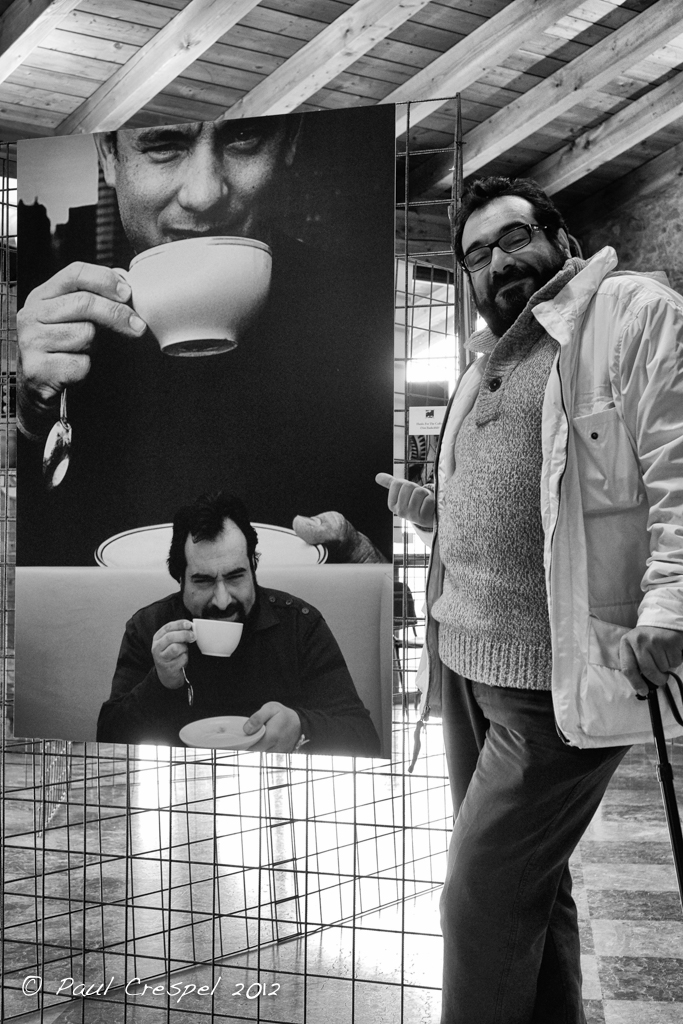
This gentleman is a well-known personality in Alassio, Liguria, Italy. Alassio character by Paul Crespel, on Flickr
-
Setting up a six-week, 80 image exhibition of Street Photography in Alassio (SV) - Liguria - Italy TIMELAPSE VIDEO - 90 minutes compressed into just over 2 minutes. CLICK ON IMAGE TO LINK TO FLICKR VIDEO Alassio 2015 Allestimento by Paul Crespel, on Flickr CLICK ON IMAGE TO LINK TO FLICKR VIDEO
-
Hello Sophie This is just one forum of many, covering just one, tiny aspect of the truly vast subject of street photography. Have you looked at the other forums here, such as architecture, people at windows, kids & teenagers, street markets, loneliness / solitude, and shop windows? Even with those other categories you are seeing just a tiny selection of street photography. Forums, by their nature, tend to "categorise" different subjects, and it's very easy to judge an overall subject by seeing just one, tiny part of it. The "gimmicks" you refer to are real occurrences, they were not posed. If you look at any of the books of photographs by Robert Doisneau, Elliott Erwitt, Gianni Berengo-Gardin, and many, many others, you will see that they were photographing those "gimmicks" 50 or 60 years ago, and those gentlemen were the pioneers of street photography. Doisneau and Erwitt, in particular, show amazing senses of humour and irony in the work they produced from the 1950s onwards. Street photography is not "heading" anywhere... it's still doing exactly what it did since Henri Cartier-Bresson started back in the 1930s, almost one hundred years ago, as you will easily see if you visit any exhibition of street photographs taken in any of the last 8 decades
-
wedding shoot, recommendation needed for focus settings
Paul Crespel replied to shane's topic in General Discussion
And even if they asked you, you must be honest with yourself, and with them, or you stand a risk of losing a lot of friends. Seriously, Shane, think hard before you do the wedding -
wedding shoot, recommendation needed for focus settings
Paul Crespel replied to shane's topic in General Discussion
Hello Shane, A wedding is a very important event, which can't easily be rewound and replayed for a re-shoot if you get the photos wrong. My advice to you is, if you need to ask such a question, then perhaps it would be better to have the assurance of an experienced wedding photographer present to ensure backup for any mistakes. You don't get a second chance at a wedding, and if you screw up through lack of experience, you are going to disappoint the wedding couple, their family and their friends, and possibly leave yourself open to a lawsuit. In a church (down the aisle), a telephoto is not ideal. You need 21mm or 28mm to allow for low light, and the depth of field and surroundings to give the photo some context. You don't want to blur the background in the church, you want to include it. Really, think very carefully about covering the wedding until you've followed experienced wedding photographers enough to understand what is expected, and to have enough experience not to screw up. It's a BIG responsability -
STREET PHOTOGRAPHY EXHIBITION ALASSIO (SV) ITALY
Paul Crespel replied to Paul Crespel's topic in Street Photography
Amusing video - click on the image to viewAlassio 2015 by Paul Crespel, on Flickr- 2 replies
-
- 1
-
-
- Italy
- Paul Crespel
- (and 4 more)
-
Hi dbspano, reach is sometimes a problem, as is not having a wide enough lens, but I try to compensate for both these issues, as far as possible, with my legs My guess is that even if you take 3 cameras with 6 lenses there will always be times you "need" something else, so the problem is not with the choice of camera or lens, it's in your mind, in your approach to what you want to achieve. Make a choice, and then be happy to accept whatever advantages and limitations that choice gives you. If, instead, you continue to think "what if....?" then your photography may suffer because you're not thinking positively When I travel now purely for holidays, despite having about 9 cameras, I always choose the X100s. Sometimes I'm too far away, and it's just not possible to get closer in time to get the shot, but I know that if I were to use a telephoto lens, the perspective would be shortened, flattened, and the photo would look like it was taken with a telephoto lens. That may be acceptable for wildlife, sports, etc., but it is not ideal for city, street, or people photography, because such a flattened perspective psychologically removes the possibility of the viewer feeling as if they are inside the printed photograph. Telephotos destroy any sense of "natural" - as do extreme wide-angle lenses.
-
Nice one saltyfog, you got the shadows, I got the foreground
-
Hi dbspano, take a look at my facebook page, nearly all the photos were taken in Italy with an x100 or x100s.
-
Mario's Kitchen by Paul Crespel, on Flickr
-
Hi Magnesi, thanks! If you find yourself in Italy at any time, I usually have at least one major exhibition somewhere... they're even better printed on Canson Baryte paper, nice and big, and framed without glass to give the best possible view. Another exhibition starts on Monday in Liguria, and will last six weeks. If you ever do make it here, let me know and I'll try and get there to meet you.
-
Hi Magnesi, I'm not qualified to criticise Whether I like or dislike a photo is only my own opinion. A photo can be great for some people, and awful for others, and another photo can be the opposite. People can like or dislike photos, but nobody has the right to judge or criticise other people's photos, as that will be only their opinion, and that opinion will always conflict with others' opinions. The only person who has the right to judge or criticise your own photos is YOU Others should only like or dislike.
-
STREET PHOTOGRAPHY EXHIBITION ALASSIO (SV) ITALY
Paul Crespel replied to Paul Crespel's topic in Street Photography
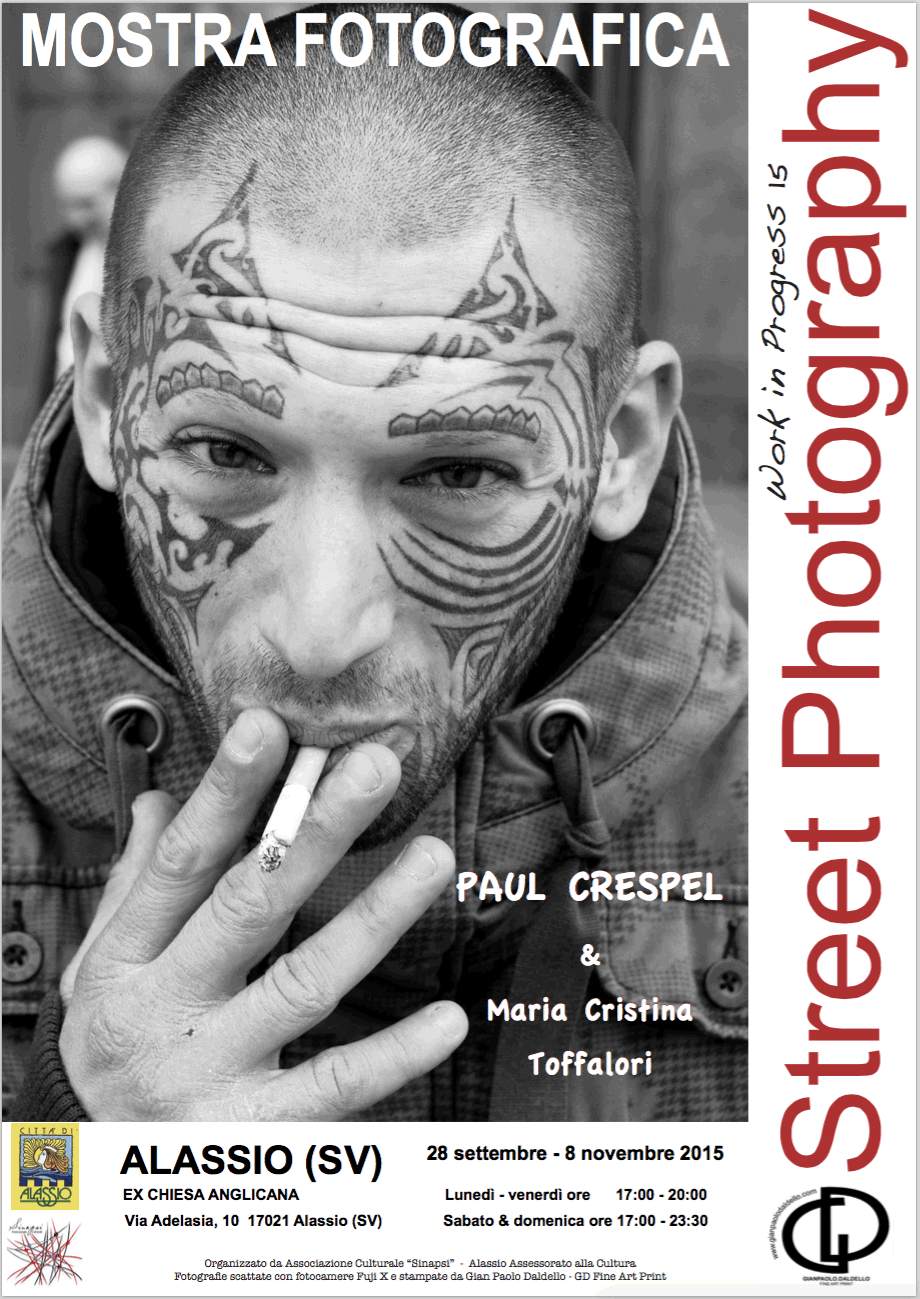
ALASSIO (SV) - EX CHIESA ANGLICANA Via Adelasia 10, 17021 Alassio (SV) Lunedì 28 settembre - domenica 8 novembre 2015 Lunedì - venerdì ore 17:00 - 20:00 Sabato e domenica ore 17:00 - 23:30 EVENT FACEBOOK