Leaderboard
Popular Content
Showing content with the highest reputation on 12/05/2024 in all areas
-

Adapting telescope (2" focuser) to Fuji X?
jerryy reacted to Astigmatism for a topic
Wow, jerryy, you knocked this right out of the park! Thank you! This would be great as some permanent sticky! I think I have ordered something that will work. It's M42, not M48 -- I couldn't find both parts in M48 on Amazon or B&H Photo. However I bet this will not cause any vignetting. I've had tools for predicting vignetting, but don't know where working ones are, so I'm gambling a little. What I ordered: Astromania 2" T-2 Focal Camera Adapter for SLR Cameras Fotodiox Lens Mount Adapter Compatible with M42 Screw Mount SLR Lens on Fuji X-Mount Cameras I already have one of the Fotodiox adapters which I built into an adapter for mounting a microscope objective 160 mm from my camera sensor. It can be trusted. However it doesn't minimize the length added to the optical path, and I didn't find any others that were shorter. The scope is an "Orion SkyQuest XT10 IntelliScope Dobsonian Reflector Telescope" (this name is almost as long as the optical tube). My manual doesn't list the back focus distance, but I am hopeful, because using 2" eyepieces requires a special adapter that extends the focusing tube outward, as if the back focus is surprisingly large. Thank you for a very thorough useful answer!!1 point -

Adapting telescope (2" focuser) to Fuji X?
Astigmatism reacted to jerryy for a topic
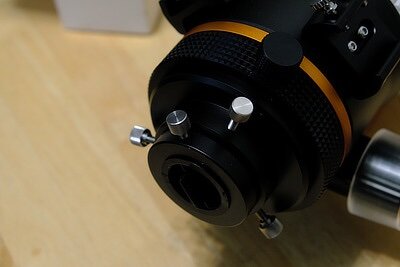
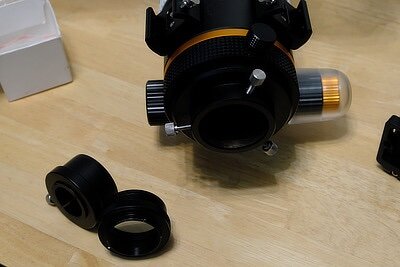
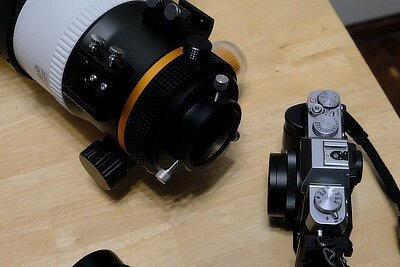
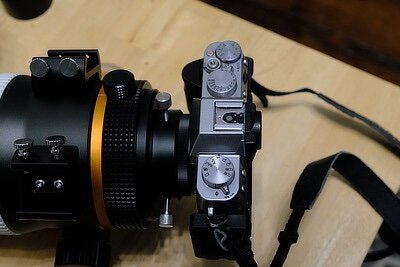
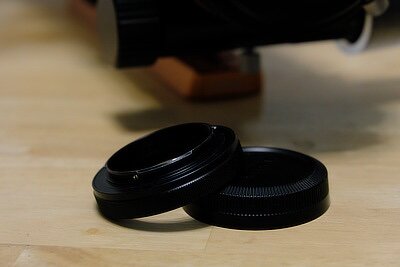
The M48 to X-Mount adapter with lens cap. The focuser. Loosen the three (screws / bolts) and remove the inner part. Inner part removed and some M48 extension tubes are added to the adapter. Just use long enough extensions for the focuser to hold onto the combination but not so long that when you put them into the focuser, it hits the secondary mirror. That will cause a lot of bad juju. (The small mirror at the top of your Newtonian is called the secondary). Adapter combination attached to my trusty X-T10. Slide the tube into the focuser, tighten the (screws / bolts) and you are good to go. 1 point
 -
Adapting telescope (2" focuser) to Fuji X?
Astigmatism reacted to jerryy for a topic
The shorter M48 to X-mount adapters are usually the ones that work. The trick with Newtonians is that the focus spot is almost inside the focuser. Edit: I am updating this portion, the older stuff that was here is still valid, but 'a picture and a thousand words and all of that'. If you look at the focuser closely, you see it has the outer part and the inner part sitting inside. Loosen the screws on the outer part, take the inner part out of the focuser and slide in the adapter with the camera attached. Tighten the screws and adjust the focuser as needed. The overall “trick” is to find the scope specs listing for what is called back focus (for many refractor scopes it will be 55mm, but for reflector scopes it will be very different depending on what kind of scope it is, rc scopes have very different back focus distances than do Newtonians than do …) Okay, Fujifilm X-mount cameras have what is called the flange distance (the distance from the mount spot to the sensor in the body) of 17.7mm. If your scope or accessory has a back focus of 55mm, subtract 17.7 from 55 to get 37.3mm that you need extension tubes to cover. Most Newtonians have very short back focus distances, so you almost need to have the camera inside the focuser. Other bodies, Canon, Sony, Nikon, etc. with deeper flange distances are more troublesome when trying to use them with standard Newtonian scopes. Edit: It occurs to me that I could hopefully make this a bit clearer by demonstrating with one of my scopes, so in a bit, I will post that and not rely on looking at other sites for visuals. I will try to do so quickly and come back and edit this posting. HTH.1 point